Summary:
-
Amazon Leo needs 24 New Glenn launches to close the gap with SpaceX's Starlink. NASA needs New Glenn for Artemis. Both timelines could've just been derailed simultaneously.
-
Blue Origin's New Glenn Rocket Explodes On Florida Launchpad
Will Blue Origin's New Glenn Rocket Mishap Derail Amazon Leo Satellite Launches
Ahead of Thursday night's disastours static-fire test of Blue Origin's New Glenn rocket, Jeff Bezos' rocket company was planning to launch 48 Amazon Leo satellites, formerly Project Kuiper.
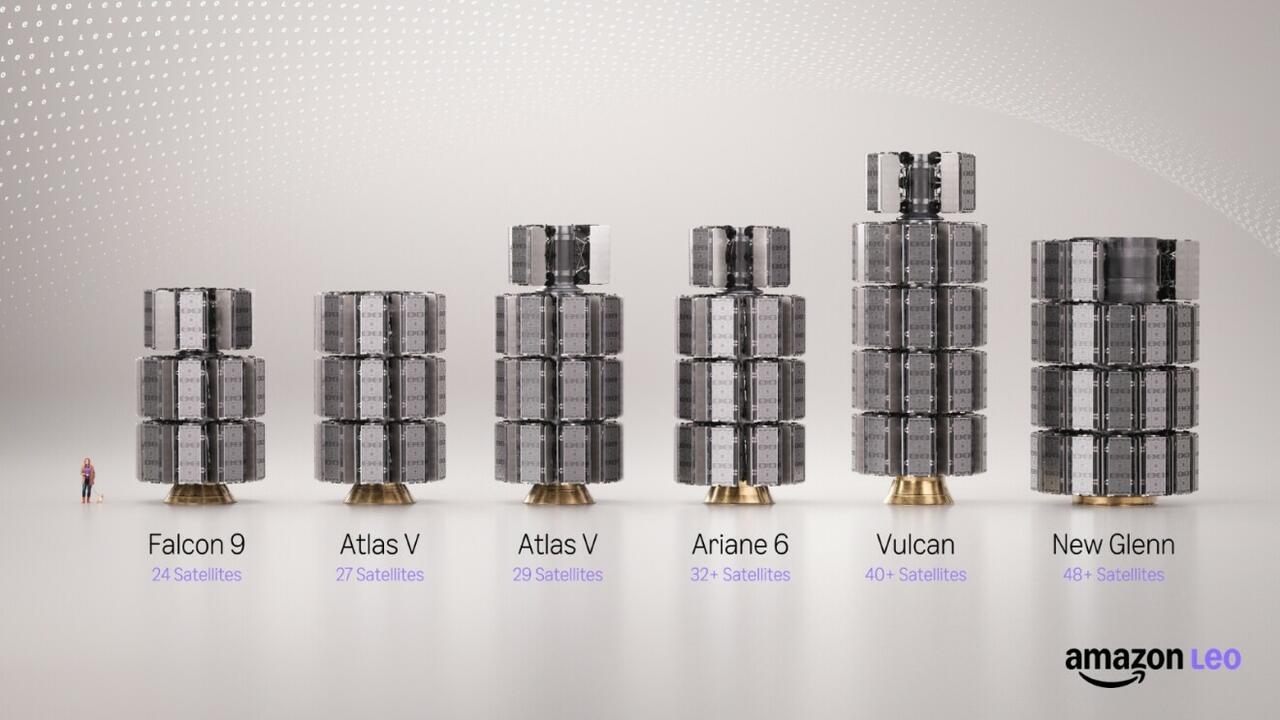
Amazon says it has completed 11 missions and launched more than 300 Leo broadband satellites. The next batch of 48 satellites was expected to be launched into LEO in early June, but last night's mishap is likely to have derailed those efforts.
?? Launch Alert | New Glenn's fourth launch will send 48 @AmazonLeo satellites into low Earth orbit as part of their growing broadband constellation. More details to come soon. pic.twitter.com/2jNAucrtPv
— Blue Origin (@blueorigin) May 27, 2026
Amazon Leo is a direct competitor to Elon Musk's Starlink internet service, which has more than 10,400 broadband satellites in space and ten million customers worldwide.
Growth is very fast (Starlink added millions in 2025 alone), with unofficial estimates putting the figure around 11–12 million by early to mid-May 2026.
One X user pointed out how "Blue Origin just vaporized a rocket, a launch pad, and Amazon's entire satellite deployment timeline in nine seconds."
NG-4 was supposed to fly on June 4, carrying 48 Amazon Leo satellites. That mission was the first of 24 contracted Blue Origin launches Amazon needs to build its Starlink competitor. Amazon has roughly 240 satellites in orbit against an FCC requirement of 1,618 by July 2026. They already filed for a two-year extension because they were falling short. Losing your primary heavy-lift rocket on the pad doesn't help that math.
The pad damage is the part people aren't thinking about. New Glenn carries roughly 2.4 million pounds of propellant. The explosion toppled one of LC-36's lightning protection towers. That launch complex took years to build and billions to outfit. You can manufacture a new rocket in months. You cannot rebuild a launch pad in months.
The cascade gets worse. Blue Origin's Blue Moon MK1 lunar lander is supposed to launch on New Glenn this fall for NASA's CLPS program. That mission is the pathfinder for Artemis III, which needs Blue Moon MK2 to fly on New Glenn in mid-2027 to land astronauts at the lunar south pole. Every month LC-36 sits damaged pushes Artemis further into the late 2020s.
Jeff Bezos has two companies betting on the same rocket. Amazon Leo needs 24 New Glenn launches to close the gap with Starlink. NASA needs New Glenn for Artemis. Both timelines just broke simultaneously, and LC-36 is on fire.
Blue Origin just vaporized a rocket, a launch pad, and Amazon's entire satellite deployment timeline in nine seconds.
— Aakash Gupta (@aakashgupta) May 29, 2026
NG-4 was supposed to fly June 4 carrying 48 Amazon Leo satellites. That mission was the first of 24 contracted Blue Origin launches Amazon needs to build its… https://t.co/Pz2Su6925C
However, as one X user explained, Bezos now has three options, and all three are, as he put it, "catastrophic":
-
OPTION 1: REBUILD LC-36 FROM SCRATCH
-
OPTION 2: BORROW OR BUY LAUNCH CAPACITY FROM A COMPETITOR
-
OPTION 3: ABSORB THE DELAY AND KEEP INVESTING
?? ?? BEZOS HAS 3 OPTIONS LEFT AFTER NEW GLENN'S LAUNCHPAD EXPLOSION. ALL 3 ARE CATASTROPHIC.
— ???? Liu Feng ?? (@LiuInTheShadows) May 29, 2026
This is the moment nobody wants to talk about.
After years of development, a $1B+ heavy-lift rocket program, and a final ground test before Amazon's Kuiper satellite mission ? Blue… pic.twitter.com/Kdsd1k3vBb
Amazon Leo has not yet released an official statement on the impacts of last night's mishap on future satellite launches.
Sigh, Delta.
Delta rejected adopting SpaceX's @Starlink on its fleet because it wanted to provide internet connectivity to passengers via the Delta Sync portal, instead of the Starlink-branded portal. Delta has since chosen to partner with Amazon's LEO.
— Sawyer Merritt (@SawyerMerritt) May 13, 2026
This will result in Delta falling… pic.twitter.com/gTt8JrYx8R
Meanwhile, American Airlines, United Airlines, Southwest Airlines, and others have announced contracts for Starlink.
Blue Origin's New Glenn Rocket Explodes On Florida Launchpad
Blue Origin’s New Glenn rocket exploded in a massive fireball while undergoing a static-fire test on a Florida launchpad Thursday evening, dealing a major setback to the Jeff Bezos-backed firm in its efforts to challenge a dominant SpaceX.
The firm was preparing the vehicle for its fourth launch, which was slated to deploy a batch of satellites for Amazon.com Inc.’s Leo, a rival satellite network to SpaceX’s Starlink. None of the satellites were on the rocket when it exploded, a spokesperson for Amazon said.
Blue Origin's New Glenn just blew up at LC-36 while attempting to Static Fire ahead of NG-4.https://t.co/tANS0dWyIH pic.twitter.com/PztxFoBqIw
— NSF - NASASpaceflight.com (@NASASpaceflight) May 29, 2026
Blue Origin said the rocket experienced an “anomaly” during the test. All personnel have been accounted for and are safe, the company said.
We experienced an anomaly during today's hotfire test. All personnel have been accounted for. We will provide updates as we learn more.
— Blue Origin (@blueorigin) May 29, 2026
Commenting on the explosion, which raised the valuation of SpaceX by tens of billions as one of its biggest competitors just saw its launch vehicle end up in a massive fireball, Elon said the event was "most unfortunate. Rockets are hard."
Most unfortunate. Rockets are hard.
— Elon Musk (@elonmusk) May 29, 2026
New Glenn, which is key to Blue Origin’s plans for space exploration, is years behind schedule and has faced longer-than-expected waiting periods between flights. The explosion is the latest blow to its reputation as a reliable alternative to SpaceX’s Falcon 9.
The rocket is set to serve a key role in NASA’s Artemis program, which aims to send humans back to the moon. It is also one of an elite group of vehicles that is supposed to deliver the most critical US national security satellites for the Pentagon.
All personnel are accounted for and safe. It’s too early to know the root cause but we’re already working to find it. Very rough day, but we’ll rebuild whatever needs rebuilding and get back to flying. It’s worth it.
— Jeff Bezos (@JeffBezos) May 29, 2026
According to Bloomberg, the Federal Aviation Administration, which licenses commercial rocket launches, said it is aware of the failure and there was no impact to air traffic. The test was not within the scope of FAA licensed activities, the agency said, referring further questions to the company.
This angle is even crazier https://t.co/bDUuiafnTg pic.twitter.com/LuLG3frNw2
— Sawyer Merritt (@SawyerMerritt) May 29, 2026
Blue Origin recently launched New Glenn on its third flight in April. The rocket successfully took off and the vehicle’s booster landed on a company barge at sea. However, the upper portion of the rocket experienced an issue in space and didn’t achieve enough thrust, failing to put the satellite it was carrying for AST SpaceMobile Inc. into the proper orbit. Ultimately, the satellite fell back to Earth and burned up in the atmosphere.
The FAA had recently approved Blue Origin’s investigative report that analyzed the issue on the third flight, and the company said corrective measures had been implemented.
Insane footage filmed from a nearby restaurant shows tonight’s explosion of Blue Origin’s New Glenn at Cape Canaveral Launch Complex 36 (LC-36). pic.twitter.com/2jahDKHKhq
— OSINTdefender (@sentdefender) May 29, 2026